April 25 2014..... A Train for Thought


Every time I hear the ACR train whistle I smile. It is an immediate reminder. The wilderness is only a few hours away. But for how much longer is anybody’s guess.

Talk of the ACR passenger service to the lands north of the Sault has heated up coffee stops for several weeks now. And since spring is still under winter’s thumb, there has been a lot of opportunity to share what the loss of access to the ACR corridor will mean. I look upon the ACR as an amazing part of our heritage.
The ACR hauls around a lot of history. The other day I took some time and poured over a 1980 ACR map. I followed the winding curve of the track and counted out 44 stops, each with a unique name. Some of them, like Searchmont, Achigan, Montreal Falls (affectionately known as 92), Canyon and Dubreuilville are still used today. Others, like Horsey and Bucyrus, have fallen away with time.  But every name had an importance. There’s the town of Hearst, named after a former Sault resident, William Howard Hearst. He had studied at Osgoode Hall and became a lawyer in 1888. For some reason, (maybe his compass pointed north too), he ended up practising law in the Sault. It wasn't long before politics was his forte. In 1908 Hearst was an elected member of provincial parliament; in 1911 he became minister of Forestry and Mines.  Then, 100 years ago, in 1914, when Premier James Whitney died, Hearst became the new Premier of Ontario. He was the kind of man who looked out for workers and believed in compensation for injuries. He developed reforestation and fire prevention programs and also provided loans to settlers.


Qualities of light on snow inspired Franz Johnston .


An irreplaceable gift from the ACR is the way it sharpens the artist’s creative edge. Frank Johnston was a painter who came to Algoma in 1918 with the first members of the Group of Seven. He fell in love with the landscapes that he saw on his trips up the ACR. In a 1919 Algoma show,Johnston contributed 60 works, more than any other artist.
The area around Hearst and Franz was deep inspiration for Johnston. Although he moved to Winnipeg in 1921 to become principal of Winnipeg School of Art until 1924, Ontario called him back. Johnston returned and taught in Toronto at the Ontario College of Art from 1927 to 1929. But it was his connection to Algoma and Northern Ontario that had rooted into his soul. So much so, that in 1927 he changed his first name from Frank to Franz, after the town on the ACR line.

Another special locale is Hawk Junction. In 1909, ACR officials established “Hawk” as a crucial stop along the line. A vibrant community sprang up. In 1923, when a fire destroyed the town, residents pulled together and rebuilt everything. The train station there is a step back in time. It would make a marvellous movie set. The impressive, two-story brick structure even could be a candidate for heritage status. Several years ago, I took the train from Hawk up to Hilda to spend a couple of days at Errington’s Wilderness Resort.  I bought my ticket at the original wicket. I sat on the worn, oak bench where a waiting passenger, decades ago, had carved a fancy, handwritten initial H  into the arm beside the seat. Such intimate details add to the overall magic of train life. And no doubt the ACR has been magic for thousands of people.

ACR station at Hawk ... courtesy Panttila family album

Local videographer, John O’Donnell, tells the story of how during a film shoot of the ACR he captured some remarkable footage. His camera was running as the engineer on the passenger train opened his window before approaching a steep grade. As the train slowed climbing the hill, a raven flew alongside his window. When the speed was just right, the engineer handed off some food - he gave the raven half of a sandwich! O’Donnell says that the funny thing was a young raven was flying about twenty feet behind the mother. The engineer thought that the mother was teaching the young one the ropes.


A favourite raven on his favourite perch


Mmmm. Could there be some learning here? Can we teach the next generation what Northern Ontario can mean, to us as well as to the rest of the world? There is spirit and hope in the wild spaces. There, folks can find their true self in their own private way. That is a rare thing in these changing times.


No doubt the future will be a digital one, where most experiences are virtual. But maybe we can help some of the real ones stick around for a little while longer. Like that long, slow whistle as the passenger train pulls away from the station.


The ACR train heads home.


April 3 , 2014

The icebreaker came.In the middle of the night.  And by morning,  ice bound ships from Thunder Bay had left. CCGS Pierre Radisson to the rescue again.

Raining Stars  by artist/photographer Paula Trus who captured this time lapse image in the early hours of  April 3, 2014 at Montreal River Harbour. Lights on the horizon from the stranded ships share the night sky with the stars. 

April 2,2014


                                       Fisheries and Oceans Canada/Canadian Coast Guard
The icebreakers cometh. They grind their way through the frozen lake. They open the path for the others to follow. And they hope that Mother Nature will navigate the way.


Depending on sun, wind and warmth to help out with the melting of the ice on the lake is a good idea. Nature will provide the balance while we seek a myriad of ways to cope with this extreme weather.Distractions work well. Between snowshoeing, shovelling, Season Four of Downton Abbey, the Olympics and the recent Juno awards the days are full. During the televised Junos I laughed at the exchange between Serena Ryder and twins Tegan and Sara. They joked about forming a group called the Frost Biters, in honour of this year’s crazy cold winter.

But extreme winter weather is much more than an annoyance to the sea faring segment of the Canadian population. The shipping industry has to rely on the spring break up. When winter won’t let go without a struggle, then it is time to bring out the big, er maybe bigger, ships. Ice breakers are a tough breed and they are in a huge demand right now. The Canadian Coast Guard has 16 icebreakers to operate in Eastern Canada and the Arctic. There are two heavy duty icebreakers, four medium ones, eight multi-purpose vessels and two hovercraft. In addition, there is one vessel with icebreaker capacity on the Pacific Coast.

There’s a desire now to get on with the Great Lakes shipping season. The U.S. Coast Guard began their annual spring ice breaking in Thunder Bay on March 27 and the St. Lawrence Seaway’s 56th navigation season started March 28. That was a special day for Algoma Central Corporation. The Algoma Equinox, the first of their series of eight, new, energy efficient “Equinox” ships, went through Lock 3 of the Welland Canal.
The new ships are needed. But so is an ice free lake. So I checked with the Canadian Coast Guard to see what icebreakers MIGHT be coming our way to help out. Right now the Samuel Risley is cracking up eastern Lake Erie and the Griffon is chewing up ice on the St Lawrence River.
The diesel- powered CCGS Samuel Risley, built in BC in 1984 is about 70 m long and almost 14 m wide with a draft of just over 5 m. This ship has a cruising speed of 12 knots and hosts nine officers and 13 crew members. In 1858, Risley (pronounced is), became the first Chairman of the Board of Steamship Inspection. He was a pioneer in ship safety regulation.


CCGS Samuel Risley   Fisheries and Oceans Canada/Canadian Coast Guard


CCGS Griffon  Fisheries and Oceans Canada/Canadian Coast Guard

Another older icebreaker, the Griffon, was built in Quebec in 1970. About the same size and speed as the Risley, the Griffon has nine officers and 16 crew members. You can watch the Griffon on Utube to see, hear and almost feel the crunch of breaking ice.
This vessel is named after Le Griffon, a much, much older ship, which sailed the Great Lakes in 1679. On her maiden voyage, the ship sailed the then uncharted waters of Lake Erie, Lake Huron and Lake Michigan. But it vanished on the return trip, with no remains ever to be found.


CCGS Pierre Radisson  Fisheries and Oceans Canada/Canadian Coast Guard

 A third ice breaker, a bigger, middle brother to the Risley and the Griffon is the Pierre Radisson. Built in BC in 1978, the ninety-eight m long Radisson has a strong and powerful diesel-electric motor. She can plow her way through ice a meter thick at a speed of 6 knots. Named after Pierre Radisson, the French fur trader who explored Canada’s north in the mid 1600s, the Radisson makes the Arctic its usual ice breaking theatre. However, this year it has journeyed our way to loosen Lake Superior’s deep heavy ice and thick drifting snow.


Some say the Great Lakes ice is the worst it’s been for decades, while others say it’s the best. But, there is no doubt that the presence of such a huge ice pack has had a huge effect. Some of that can be most positive. The quietness, freedom and clear air of so much open space pull on one’s personal magnet. The peace and calm, the muted colours and the blinding bright light radiate a sense of well being.  Good medicine for the tired soul.
But the satellite view of Lake Superior shows that the lake cover is changing. Cracks in the ice resemble old paint peeling off the wall. This heralds the end of our icy season. Our sidewalks are going to sink into the lake. Slush will claim our walkways. The ice paths will be a memory. That broad, bright, white expanse, which has lit up the lake for a couple of months, will dim to grey before becoming a brilliant blue. Some will cling to their digital pix of long walks on all that hard water and others will cheer the return of Lake Superior’s open water.
There’s a unique music to this ice demise. Tinkling shards and crashing chunks, the last sighs from a long hard winter, succumb to the demands of the sun. We applaud such orchestrations. We will add them to our play list, turning up the volume as the iceman leaves the shore. But, somehow, I think that there might be a few who would rather be singing Serena Ryder’s song, Baby Come Back.


Row, Row, Row the Boat


     A T-shirt would be a fun. One that says “I Survived the Polar Vortex 2014” on the front. And on the back we could write down all the strange, funny things we had to do to make it through this incredibly long, will-it-ever-end winter.

Seriously, folks did have to use all their resources and inner wisdom to solve some of the problems with the cold.
     Whether it was depending on a friend’s garden hose for water because the kitchen pipes froze or finally figuring out which scarf keeps the wind from biting off your face, ingenuity was the name of the daily survival game.For sports fans, the Sault once more gave spark to winter events.
     Congrats to the Sault’s 16-year- old St Basil’s student, Mac Marcoux. He won Paralympic gold and two bronze for visually impaired skiing.The young athlete, the youngest of Canada’s Paralympians, showed amazing maturity and common sense when he had to face some difficult disappointments. When his brother BJ couldn't lead him down the hill, Mac praised his bro. He indicated that even though BJ wouldn't be the one skiing in front of him, BJ was the one that got him there in the first place. And then when his radio communicator disabled just before his run, Marcoux followed Robin Femy, his brother’s replacement lead skier, with the calm resolve of “I hope and pray I make it down”.
     The youthful Marcoux exhibited how the world opens up if we can take the time to “see”. The small birds, like the finches, are one example. We have had quite a few at our feeder for most of this 2014. In January, during the minus 30 C days, the lively friends hop from seed to seed, singing away, their little bodies somehow withstanding the cold. Now that the winter is waning, their greyish hue is turning to the brilliant reds and yellows that so distinguishes the males from the females. No digital calendar or app tells the birds to become more colourful. The finches just have the will to do so. No doubt the sun dictates the change and the new little feathers listen and respond.


Just as plants in the window turn towards the sun, I sometimes find myself watching the passage of our old sol. On the massive expanse of frozen Lake Superior, the movements of light can be dramatic. As the sun rises behind our house, light and shadow dance around the icescape. On a clear morning, first light appears on the horizon as a bright pink line. In no time at all, it then becomes a shimmering white. The shadows in front of this line are a solid mass of blue and black. After a few more minutes the shadow defines itself into the shape of hills, cliffs and trees. Finally, like watching a film develop, I can see recognizable shadow shapes. The flower clump of pine trees and the arrow head of white spruce appear on the frozen lake. Before long, the sun shreds these shadows into a few dark ribbons.


Observing the movement of light and dark turns the world into a simpler place, creates an easier way of being.  I had experience this winter with how logic and common sense can diffuse a harried situation. We were on a holiday this winter (yes we escaped for a week to a warm clime). One evening as we queued outside a restaurant for a dinner reservation, a young mother came out of the eatery with a tired, screaming child in her arms. The poor mom was trying to soothe her unhappy daughter and to give distraught fellow diners a break from the crying. We saw her attempting to calm the little girl but to no avail.  Then a very simple solution presented itself. All of us waiting outside began to sing Row, row, row your boat. The child stopped wailing and began to hug her mom. The relieved parent re-entered the restaurant, but not before turning to us and mouthing a silent thank you.  


Spring Equinox sunset

We are in the home stretch now. On Thursday, March 20, at 12:57 pm, we cheered in 2014’s first day of spring. Like it did for Mac, when he had to navigate the hill at the last minute with no listening device to guide him along, common sense can come to the rescue. Especially when we need it the most. Like that T-shirt. We just have to pray for the warm weather so we can wear it.


Long Hard Miles to Play


wind walks on the ice


Long Hard Miles to Play

This darn cold wind.It makes staying warm even more difficult. Even though we have a zillion options. We can sit on radiators or cuddle up to wood stoves. Hot rocks are toasty for fingers and toes. Down parkas, duvets and up-to-your-knees shovelling work too. And of course all that jumping around and cheering during the Olympic Games sure helped.

If there was a gold medal for watching the Olympics, then Canada would have won that one too. Congrats to Team Jacobs, Team Jones, Women’s and Men’s Hockey for not only winning medals but also giving us something to get the blood pumping.
Even watching the audience participation was exciting. Energy from the hoots, hollers and fist pumps of curling supporters at Sault Ste Marie’s Essar Centre was enough to light up the city. And the televised clips of the exuberant hockey fans in Vancouver’s Liberty square, Toronto’s Atrium and Bubba Ray’s Sports Bar in Halifax gave watchers an extra kick to the game.
Wondering about the aftermath from all this hoopla, I called Bubba Ray’s and spoke with Woody, the GM of the Sport’s Bar. When asked about how it’s been, now that the Olympics are over, Woody laughed. “We have an Olympic hangover,” he said.  “We are taking it easy and had two days off to recoup.”
Woody explained that for the Sunday morning gold medal Canada/Sweden hockey game his 604 seat restaurant bar was full to capacity. “Fans with face paint and jerseys were lined up outside at 4:15 am,” he said. “I opened the doors myself at 5:00 am. We made an awful lot of breakfasts that morning.”
A dedicated fan, Woody feels a definite attachment to special sporting moments. “I always remember where I was when Joe Carter hit his home run and I was here at Bubba Ray’s when Crosby scored his golden goal,” he said. “There are a few events you always remember.”
Indeed. Millions witnessed the soul gripping efforts of the athletes. There was magic in every event and the closing ceremonies overflowed with inspiration. They put gold in my heart when light wizardry turned the floor into rolling ocean waves with hundreds of silver clad dancers who resembled fish. And at the very end of the performance, when a thousand children, each with a branch of blossoms, promised the arrival of spring, I remembered that this season’s rigid grip of cold indeed will loosen.
Even though the roots of our own wild flowers languish under six feet of snow and the biting winds turn a – 20C day into a -35C one, we can draw up the sweet scents and voices of spring. I remembered that in January I had the fortune to hear an actual spring sound. When I first heard the robin I figured I must be daydreaming. It was a sunny day with a temperature in the -20s C. Successive days of hearing the familiar song and one afternoon seeing the actual red breast among snowy branches solidified what I knew to be true. And then our neighbour, Rick Roussain,  called in mid February to say that he had a flock of at least 30 robins in his yard! The callers of spring were swooping down to the open water of the Montreal River then returning to the mountain ash trees for a berry feast. The birds were in their own Olympics to see who could get to the berries the fastest.


Such brave feathered friends. They had decided to stay north, had found the stamina to endure the severe challenges of this extreme winter. And to keep warm? Well, they huddle together and shiver. Not quite like gathering together and cheering, but similar. They too know they are in this for the long run. As the announcer said during the gold medal hockey game as he watched the players pass the puck on that Olympic sized rink, “These are long hard miles to play in a game like this.”


Yes, we are in the midst of a long hard winter, the mythical kind when everyone is tested. But hang on folks. The days are longer. The light is returning. Soon there will be a bright March day when the sun’s warmth will begin the melt. We will be able to loosen coats and abandon hats. We will cheer and rejoice in the fact that we participated in this special winter, this extreme event to remember, which should make the return to spring all the sweeter. 

Ice, Train, Otter Tracking


Fifty years can be a long time. Hard to believe that this week in 1964 the Beatles made their first visit to our side of the Atlantic Ocean. The genius of the Liverpool’s Fab Four stirred up the creative soup for millions. And John Lennon’s later release, Imagine, said what we were all doing when the world heard them sing.
     The imagination is a powerful thing. It can turn a dull moment in a shiny one with the blink of a thought. And imagination gives relief from budget talks, Olympic disappointments and worry over the ending of passenger service from the Sault to Hearst. Yoikes. How could CN do such a thing? Don’t the shareholders know that the ACR train is a unique portal into a deep enchanting wilderness? I say get Bill and Melinda Gates to take a trip up the ACR. Then they might understand the importance of our beloved route. But enough of that rant. I’m here to talk about what’s happening on Lake Superior.
     This is a rare year. The lake is freezing over. Now the advance of the ice almost is complete. Eleven years ago, in 2003, the lake almost froze over, except for the western areas along the Minnesota shoreline. But it was seventeen years ago, in 1997, that Superior last felt the total freeze up.
     This has been quite a rapid solidification of the water. According to NOAA Great Lakes Forecasting System, on January 10 Superior had 37% ice cover. On February 10 the report was 88% ice cover but, really, for all intents and purposes, there is ice everywhere. We can imagine it or even see it for ourselves as a satellite image at Lake Superior Modis Imagery. An adventurous soul could walk, ski or snowshoe from Whitefish Bay to Michipicoten Bay. A wild daring one could imagine a journey across the centre of the lake where NOAA says there is “an unusual presence of ice”!
     Myself, I stick pretty close to shore. I’ve witnessed too many storms and deep waters to have full confidence on the big white. Seeing the ice form also magnifies the illusion that a sudden CRACK could open up an abyss. Before there is a solid surface there is a constant toing and froing of pack ice. There was such a buildup of ice sheets this year that in some places there has to be a solid 3 metres of broken up mass, straight to the bottom. What a wild world it must be under there.
Otter Track
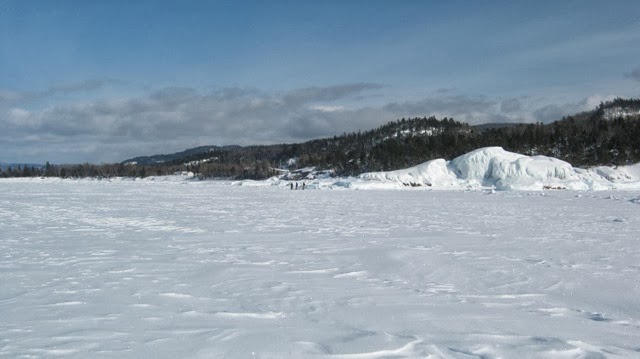
     Two days ago I took to my skis and inhaled some sunshine, fresh air and the quiet beauty of the vast frozen lake. There wasn’t a breath of wind and the sparkles on the ice and snow were fairy dust. I slid around the remains of broken pack ice, the sharp shards rising like shark fins, falcon wings or dragon teeth. After rounding a nearby point, my skis took me beside the unmistakeable tracks of an otter. When no one was there to watch, the winsome creature had ventured out onto the ice also. The length of its slide was amazing, almost the length of my skis. I followed the tracks for a while and saw where the otter had been sitting in a small ice cave along the shore. The otter’s trail then led me to a remarkable, almost unbelievable discovery. At the very tip of the point, I could see marks were the athletic creature had emerged from a crack in the ice.
Otter Hole
     Somehow, using its nature given gifts, the otter had manoeuvred its way through the mash of pack ice. I imagined its’ route, as the otter must have dipped and dove around huge broken underwater slabs. I visualized it seeking the light, holding its breath then emerging above ice. What a journey.
This broad white plain before us has a magnetic call. We dream of fishing holes or ski trips and other worlds on the far side. This is our brief time with the frozen lake. Best to take time to enjoy this phenomenon. For who knows when it will come again?

Verve, Voice, Visitors


     The quiet time is here. Winter has staked its claim and the lake is trying to sleep. The busyness of summer is just a passage in last year’s journal.


     One of the most noticeable effects of this sleepy time is the lack of traffic on the highway. The scrape from snow plows and the rush of transports is there, but missing are the dozens of canoehead cars and skinny wheeled bicycles. The world loves the north but most people can only venture there in the warmer, safe-to-travel days.

     For folks who live in the north, in small rural communities or in hamlets along the lake, this change in space is a familiar one. However, the absence of people does not diminish the fact that where they live is important. Take, for example, the plight of tired workers who sit in front of a computer all day. To keep their minds fresh, they often flip to photos of their favourite haunts along Lake Superior.


     Lake Superior has pulled in people from all over the world. Over the years we have been lucky enough to meet quite a few. I remember with a smile, and awe, some of the first visitors to our place. Some years ago, Tzanka, a small troop of dancers from Russia on a cross Canada tour stopped here in Montreal River to perform at the local school. They brought an energetic musical part of the planet right to the front door. Some of the more recent visitors have been cyclists. They are the adventurous souls who brave the gravelly shoulders on the Trans Canada to grind their way up, or zip their way down, the Montreal River Hill. They add a unique verve and voice to the shore. Today, in 2014, the love and life in Superior’s eastern shore has an even broader base. Social media has umped the ante. A visit to the lake and Lake Superior Park is on a multitude of sites.


     While summer is the most popular time to see the lake, winter offers unique and often startling views and contemplations. The variety of light, form and colour is unbelievable. Some sunset evenings the light dances off the lake with a pink, red and gold radiance that fills the entire sky. Some sunny days crystals of snow are flakes of silver. One morning ice patterns are swirls and squiggles on a smooth flat surface. The next day rolling plates of pack ice resemble the scales of a dragon. The scene never stops giving and changing.


     Often, insight from the lake can be quite unexpected. One winter, during a year when the winds were calmer, the lake froze smooth and solid enough to ski on in places. We went to Sinclair Cove in Lake Superior Park and skied about a kilometer south to the pictographs on the cliff face of Agawa Rock. There, the ancient ochre coloured paintings that depict lake travels and lake creatures are a draw for thousands.


     It was a gorgeous sunny day and all of us were taken away by the beauty and fun of our icy excursion. We skied to look at the paintings and then went further out onto the lake. At about 50 metres from shore I started to notice how the sounds were different. Laughter from our group echoed off the cliff walls. In a quiet moment I whispered. It was a shock to hear my soft whisper return to me louder than I sent it. And from so far away.
     The lake does have a million voices and faces that influence the world. A global network of people share and enjoy this beauty, a beauty that puts us in the moment, a moment that reminds us to breathe and remember what is important.


     Some travellers might look around and say that the frozen north is in the middle of nowhere. But another look might reveal something else. Instead, they could be now-here. And that’s something to appreciate while the lake takes a rest.

Winter Reflektions


I’ve never seen a winter like it. Ward even asks, “What would be different if this was the beginning of the next ice age?” No wonder the mammoth was woolly.
     We have been clinging to our wool sweaters and felt lined boots for a few weeks now. With either a blizzard blinding our way or freezy temps doing things to our eyelashes, stepping outside has been an event. And, what about all the people in Toronto, Newfoundland and the States who face days without electricity? The intensity of the latest round of severe weather is making us feel like we really do live in the frozen north. Although, the outdoor hockey classic game did make snow and cold look like fun.
     A winter like this one brings up some of my childhood memories. I see my mom wrapping a scarf around my mouth, nose and chin, then tucking my mitts into jacket sleeves so I wouldn’t freeze when I “played outside”. I feel my toes turn to ice cubes on the outdoor rink and hear the thud of my skates as I pound on the wooden floor of the rink shack trying to warm up my feet. And I smell the pungence of wet wool as the shack’s woodstove coaxes ice balls off droopy mitts.
     Actually, once the layers have coated our bodies, the winter out of doors is a beautiful place to be. Frost flowers bloom on windows. Clear frigid nights showcase a thick, black velvet sky where millions of brilliant, blinking stars appear to be close enough to pluck like berries on a hot summer day. Then, at sunrise, pink cotton candy steam clouds rise off the rolling shoulders of Lake Superior. Here at Montreal River the lake still is resisting the ice. One day you can see miles of a moving ice sheet. Two days later the wind rules and obliterates any sign of an ice blanket. Watching the lake/ice capades and listening to Arcade Fire’s new CD Reflektor is a fine way to spend an hour on a Sunday afternoon.


     But wait a minute. I thought that we were supposed to be suffering the effects of global warming. Or maybe we are. What is going on this wild winter? Time to check out some science.
     Yes it has been warm—emphasis on has. Scientists from the American based NOAA (National Oceanic and Atmospheric Administration) say that the global average temperatures over land and ocean surfaces for November 2013 were the highest for November since record keeping began in 1880. Then December rolled in. Followed by our January 2014!
     NASA (National Aeronautics and Space Administration) has some explanation for the recent freeze out.  They say that a Polar Vortex, a strong west to east jet stream that contains a large scale region of frigid air has been making its counter clockwise rounds. This vortex has a shivery nickname too. Some call it the Polar Night Jet. Oooh! Cancel flights on that one. They might make you nauseous.
     The earth has had periods of very cold winters before. In 1939 Francois Matthes penned the words “Little Ice Age” (LIA) to describe three cold periods between the years 1550 and 1850.  Society embraced the idea and it thrives to this day. The LIA terminology conjures scenes of glacial mountains and a cave with a fire. However, science is just talking about severe winters. Period paintings of skaters on the Thames River in England combined with modern sediment and ice core samples prove that, indeed, there were some very cold years. The coldest winter on record in Europe, where the record keeping predates North American data, was in 1683/1684. And yet two years later Europe had the sixth warmest winter. Nature rides a seesaw trying to find some sort of balance. Remember that March not long ago when we wore shorts and tee shirts in 30 degree weather? Abrupt changes are a part of the plan.
     Global warming and/or extreme climate changes are a fact of life. Whether these intense weather systems are normal or not is a moot debate. Deciding how to control or change them is constant chatter. The fact is we have to live with this weather.

     So what shall we do? What we do best—make the best of it. For when the power goes out, our other power turns on. We go to our reserves. We share stories, legends and songs about the cold. We haul out genetic memories of conserving energy and huddling together to stay warm. We bundle up, go outside and embrace any bit of daylight or starlight that we can. Probably the world has been like this many times before.