Ice, Train, Otter Tracking


Fifty years can be a long time. Hard to believe that this week in 1964 the Beatles made their first visit to our side of the Atlantic Ocean. The genius of the Liverpool’s Fab Four stirred up the creative soup for millions. And John Lennon’s later release, Imagine, said what we were all doing when the world heard them sing.
     The imagination is a powerful thing. It can turn a dull moment in a shiny one with the blink of a thought. And imagination gives relief from budget talks, Olympic disappointments and worry over the ending of passenger service from the Sault to Hearst. Yoikes. How could CN do such a thing? Don’t the shareholders know that the ACR train is a unique portal into a deep enchanting wilderness? I say get Bill and Melinda Gates to take a trip up the ACR. Then they might understand the importance of our beloved route. But enough of that rant. I’m here to talk about what’s happening on Lake Superior.
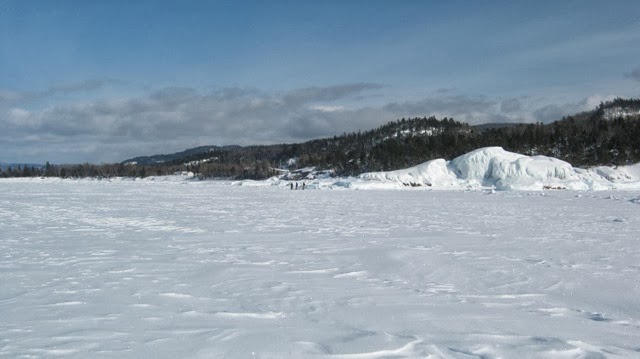
     This is a rare year. The lake is freezing over. Now the advance of the ice almost is complete. Eleven years ago, in 2003, the lake almost froze over, except for the western areas along the Minnesota shoreline. But it was seventeen years ago, in 1997, that Superior last felt the total freeze up.
     This has been quite a rapid solidification of the water. According to NOAA Great Lakes Forecasting System, on January 10 Superior had 37% ice cover. On February 10 the report was 88% ice cover but, really, for all intents and purposes, there is ice everywhere. We can imagine it or even see it for ourselves as a satellite image at Lake Superior Modis Imagery. An adventurous soul could walk, ski or snowshoe from Whitefish Bay to Michipicoten Bay. A wild daring one could imagine a journey across the centre of the lake where NOAA says there is “an unusual presence of ice”!
     Myself, I stick pretty close to shore. I’ve witnessed too many storms and deep waters to have full confidence on the big white. Seeing the ice form also magnifies the illusion that a sudden CRACK could open up an abyss. Before there is a solid surface there is a constant toing and froing of pack ice. There was such a buildup of ice sheets this year that in some places there has to be a solid 3 metres of broken up mass, straight to the bottom. What a wild world it must be under there.
Otter Track
     Two days ago I took to my skis and inhaled some sunshine, fresh air and the quiet beauty of the vast frozen lake. There wasn’t a breath of wind and the sparkles on the ice and snow were fairy dust. I slid around the remains of broken pack ice, the sharp shards rising like shark fins, falcon wings or dragon teeth. After rounding a nearby point, my skis took me beside the unmistakeable tracks of an otter. When no one was there to watch, the winsome creature had ventured out onto the ice also. The length of its slide was amazing, almost the length of my skis. I followed the tracks for a while and saw where the otter had been sitting in a small ice cave along the shore. The otter’s trail then led me to a remarkable, almost unbelievable discovery. At the very tip of the point, I could see marks were the athletic creature had emerged from a crack in the ice.
Otter Hole
     Somehow, using its nature given gifts, the otter had manoeuvred its way through the mash of pack ice. I imagined its’ route, as the otter must have dipped and dove around huge broken underwater slabs. I visualized it seeking the light, holding its breath then emerging above ice. What a journey.
This broad white plain before us has a magnetic call. We dream of fishing holes or ski trips and other worlds on the far side. This is our brief time with the frozen lake. Best to take time to enjoy this phenomenon. For who knows when it will come again?

Verve, Voice, Visitors


     The quiet time is here. Winter has staked its claim and the lake is trying to sleep. The busyness of summer is just a passage in last year’s journal.


     One of the most noticeable effects of this sleepy time is the lack of traffic on the highway. The scrape from snow plows and the rush of transports is there, but missing are the dozens of canoehead cars and skinny wheeled bicycles. The world loves the north but most people can only venture there in the warmer, safe-to-travel days.

     For folks who live in the north, in small rural communities or in hamlets along the lake, this change in space is a familiar one. However, the absence of people does not diminish the fact that where they live is important. Take, for example, the plight of tired workers who sit in front of a computer all day. To keep their minds fresh, they often flip to photos of their favourite haunts along Lake Superior.


     Lake Superior has pulled in people from all over the world. Over the years we have been lucky enough to meet quite a few. I remember with a smile, and awe, some of the first visitors to our place. Some years ago, Tzanka, a small troop of dancers from Russia on a cross Canada tour stopped here in Montreal River to perform at the local school. They brought an energetic musical part of the planet right to the front door. Some of the more recent visitors have been cyclists. They are the adventurous souls who brave the gravelly shoulders on the Trans Canada to grind their way up, or zip their way down, the Montreal River Hill. They add a unique verve and voice to the shore. Today, in 2014, the love and life in Superior’s eastern shore has an even broader base. Social media has umped the ante. A visit to the lake and Lake Superior Park is on a multitude of sites.


     While summer is the most popular time to see the lake, winter offers unique and often startling views and contemplations. The variety of light, form and colour is unbelievable. Some sunset evenings the light dances off the lake with a pink, red and gold radiance that fills the entire sky. Some sunny days crystals of snow are flakes of silver. One morning ice patterns are swirls and squiggles on a smooth flat surface. The next day rolling plates of pack ice resemble the scales of a dragon. The scene never stops giving and changing.


     Often, insight from the lake can be quite unexpected. One winter, during a year when the winds were calmer, the lake froze smooth and solid enough to ski on in places. We went to Sinclair Cove in Lake Superior Park and skied about a kilometer south to the pictographs on the cliff face of Agawa Rock. There, the ancient ochre coloured paintings that depict lake travels and lake creatures are a draw for thousands.


     It was a gorgeous sunny day and all of us were taken away by the beauty and fun of our icy excursion. We skied to look at the paintings and then went further out onto the lake. At about 50 metres from shore I started to notice how the sounds were different. Laughter from our group echoed off the cliff walls. In a quiet moment I whispered. It was a shock to hear my soft whisper return to me louder than I sent it. And from so far away.
     The lake does have a million voices and faces that influence the world. A global network of people share and enjoy this beauty, a beauty that puts us in the moment, a moment that reminds us to breathe and remember what is important.


     Some travellers might look around and say that the frozen north is in the middle of nowhere. But another look might reveal something else. Instead, they could be now-here. And that’s something to appreciate while the lake takes a rest.

Winter Reflektions


I’ve never seen a winter like it. Ward even asks, “What would be different if this was the beginning of the next ice age?” No wonder the mammoth was woolly.
     We have been clinging to our wool sweaters and felt lined boots for a few weeks now. With either a blizzard blinding our way or freezy temps doing things to our eyelashes, stepping outside has been an event. And, what about all the people in Toronto, Newfoundland and the States who face days without electricity? The intensity of the latest round of severe weather is making us feel like we really do live in the frozen north. Although, the outdoor hockey classic game did make snow and cold look like fun.
     A winter like this one brings up some of my childhood memories. I see my mom wrapping a scarf around my mouth, nose and chin, then tucking my mitts into jacket sleeves so I wouldn’t freeze when I “played outside”. I feel my toes turn to ice cubes on the outdoor rink and hear the thud of my skates as I pound on the wooden floor of the rink shack trying to warm up my feet. And I smell the pungence of wet wool as the shack’s woodstove coaxes ice balls off droopy mitts.
     Actually, once the layers have coated our bodies, the winter out of doors is a beautiful place to be. Frost flowers bloom on windows. Clear frigid nights showcase a thick, black velvet sky where millions of brilliant, blinking stars appear to be close enough to pluck like berries on a hot summer day. Then, at sunrise, pink cotton candy steam clouds rise off the rolling shoulders of Lake Superior. Here at Montreal River the lake still is resisting the ice. One day you can see miles of a moving ice sheet. Two days later the wind rules and obliterates any sign of an ice blanket. Watching the lake/ice capades and listening to Arcade Fire’s new CD Reflektor is a fine way to spend an hour on a Sunday afternoon.


     But wait a minute. I thought that we were supposed to be suffering the effects of global warming. Or maybe we are. What is going on this wild winter? Time to check out some science.
     Yes it has been warm—emphasis on has. Scientists from the American based NOAA (National Oceanic and Atmospheric Administration) say that the global average temperatures over land and ocean surfaces for November 2013 were the highest for November since record keeping began in 1880. Then December rolled in. Followed by our January 2014!
     NASA (National Aeronautics and Space Administration) has some explanation for the recent freeze out.  They say that a Polar Vortex, a strong west to east jet stream that contains a large scale region of frigid air has been making its counter clockwise rounds. This vortex has a shivery nickname too. Some call it the Polar Night Jet. Oooh! Cancel flights on that one. They might make you nauseous.
     The earth has had periods of very cold winters before. In 1939 Francois Matthes penned the words “Little Ice Age” (LIA) to describe three cold periods between the years 1550 and 1850.  Society embraced the idea and it thrives to this day. The LIA terminology conjures scenes of glacial mountains and a cave with a fire. However, science is just talking about severe winters. Period paintings of skaters on the Thames River in England combined with modern sediment and ice core samples prove that, indeed, there were some very cold years. The coldest winter on record in Europe, where the record keeping predates North American data, was in 1683/1684. And yet two years later Europe had the sixth warmest winter. Nature rides a seesaw trying to find some sort of balance. Remember that March not long ago when we wore shorts and tee shirts in 30 degree weather? Abrupt changes are a part of the plan.
     Global warming and/or extreme climate changes are a fact of life. Whether these intense weather systems are normal or not is a moot debate. Deciding how to control or change them is constant chatter. The fact is we have to live with this weather.

     So what shall we do? What we do best—make the best of it. For when the power goes out, our other power turns on. We go to our reserves. We share stories, legends and songs about the cold. We haul out genetic memories of conserving energy and huddling together to stay warm. We bundle up, go outside and embrace any bit of daylight or starlight that we can. Probably the world has been like this many times before. 

Santa at Searchmount

The week before Christmas is always kind of crazy. Cookie exchanges, list checking and late nights all roll into one blur. We can relate to Santa’s nonstop worker elves. But in the short run it is all worth it. What else are we going to do when daylight shrinks and temperatures plummet?
This advent of winter has brought out the Lake Superior steam clouds big time. In the early, minus 20 mornings, pink and yellow mountains of heat float off the water. With just a slight puff of wind the steam mists swirl across the lake. When you see that happening, you know that it is a face freezing day and time to seek comfort in food, warmth and friendship.
Family and friends do take up the front row this time of year. Connecting is crucial. This season is for greeting. But there is a change in the air. Technology and lack of funds are altering how we communicate. The latest swoop has come with the planned elimination of door-to-door mail delivery. Not that anyone is too surprised. Much of the mail is advertising and handwritten letters are on the endangered list.
We have been using a post box for over two decades. At one time a visit to our post office was a social occasion. Folks met, had a coffee and chatted up the latest story. But a few years ago Canada Post gave Montreal River the outdoor, super mailbox, which is fine unless there is a blizzard or by some error you get someone else’s mail. Then you become the door-to-door deliverer.
Wondering what the other folks might do for mail, I Googled UK, France and Germany postal services. Another perspective on a situation always helps.
In France, mail delivery started when Louis XI initiated postal relays in 1477. No email hacking for him. By 1576 the ordinary citizen could access the system. Today 100,000 post men and women deliver mail door-to-door each morning.
In Germany, workers still deliver letters and parcels. The local post office often is in a stationery or grocery store. There a separate section allows you to buy stamps, mail a package, deposit or withdraw money and apply for a credit card. That’s right. The post office is also a bank. That’s true for the UK too, where the Post Office provides other services such as insurance and the ability to obtain forms such as a driver’s license, passport or car registration.
England offers another unique option. The Postbus (the mail delivery van) has a few seats for passengers. One can hail the Postbus and, if traffic allows, the driver will stop and pick you up. Fees depend on distance and one’s age. Mail has had a long history in the UK. Henry VIII set up the King's mail in 1516. By 1635, the Royal Mail provided postal services for the public.
So mail delivery has been a global phenomenon for centuries. And there’s been one type of letter that has been quite special since 1869. That’s when a certain writer wrote out that red-suited,  roly poly gentleman’s address. That year, in the publication Santa Claus and his Works, a George P. Webster described Santa’s home as being “near the North Pole, in the ice and snow”. Gulp. Did Webster realize what he did? He gave Santa the claim to the North Pole. For over a hundred years, millions of children have written to that address. But hold on. The Canadian government has put in a bid for that floating ice sheet. How does Canada Post plan to deliver Santa’s mail? And with that rich resource beneath the two and half miles of Arctic Ocean, the elves might leave the workshop for the oil fields.
Mmmm, maybe it’s time Santa got a new address. Ontario has a lot of beautiful snowscapes, including those right here in Algoma. I like Tom Mills’ idea to build a home for Santa at Searchmount, with the Snow Train as the perfect Polar Express. And Santa could make side trips to Lake Superior to see ice castles sparkling along the shore.
Well it is 2013, almost 2014. Why not? I’ll give the old guy the suggestion.  In fact I’ll write him a letter right now.
Merry Christmas everyone and don’t forget to take your naps. Santa does.
Yours truly.

Truth at the Bottom of the Well‏


Too bad Victor Hugo never made it to Canada. Even though it’s not Guernsey, he would have liked it here. He had that kind of soul.

Knowing that I was going to see the Musical Comedy Guild’s production of Les Mis, I headed off to the public library and borrowed Hugo’s Les Miserables for a couple of months. He wrote and published his massive text in early 1860 while in exile. At the time he was living on the island of Guernsey, which he loved, but not as much as his beloved France. For me, curling up with the book each evening was a reprieve from the daily brew of grinding news. One gets overwhelmed trying to figure out who is the real coach behind the bench of the Ottawa Senate, how hockey is going to evolve and where to find the best deal on a new tablet. And I wanted to learn why the words Javert, Valjean, Fantine and Cosette have become part of our vocabulary.

This diversion to Victor Hugo has pumped up my regard for nature, which is helpful as we deal with shorter days and a deeper cold. Winter arrived early and now has settled in for the season. Maybe that excellent bounty of berries this summer was an indication of a long hard winter. But that’s ok. Like the rabbits that have turned white and the foxes that grow thick fat tails, we too, can adapt.  The latest bout of sub zero temperatures has accelerated ice formation. The water in the top layers of the little lakes has succumbed and ice now covers our favourite little mirrors. This early ice is surprising but it does bring us a favourite winter pastime - skating. While the joy in a pond skate is delicious thing, the exhilaration of a Lake Superior skate is a bit more of a shaky promise. But, it could be different this year. Ice has crept into some of the more secluded bays. Plus the Batchawana, Goulais and Pancake Rivers are glossing over. Here at Montreal River Harbour, our present version of ice is slippery bedrock. A solid Lake Superior might appear much later in the winter, if at all.

A December skate on a frozen pond is one of our unique cultural treats. Combine this with the early darkness and you can skim across the ice under a sky parade. The moon slides across the black velvet of a star riddled backdrop. Then the shower of light from the Milky Way and the bold angle of the Big Dipper steal the show.

Hugo would have appreciated the magic of such simplicity. His writing describes all that. “When after a day spent in meditation he returned home by the evening light of the boulevards and saw through the branches of the trees the measureless space of the infinite, the nameless lights, the darkness and mystery, it seemed to him that all things not simply human were of little account.”

No wonder Hugo’s words make one want to sing. The drama of his heart wrenching story, combined with Boubil and Schonberg’s music, entrances an audience. And the Sault’s Musical Comedy Guild outdid themselves with their version of this story. I was at the Kiwanis theatre for opening night and thoroughly enjoyed the performance. The singing was superb. The choreography was delightful. The interactions on stage were infectious. The performance imitated one of Hugo’s quotes from Les Miserables. “If you are a stone, be magnetic; if a plant, be sensitive; but if you are a human, be love.”

And love they were. The joy and excitement in all the performers was contagious. One could feel the anticipation right from the opening scene when the prisoners ambled down the aisle with their invisible chains, chains that held us all captive throughout the performance. Javert’s flaming torch, alive with fire, reminded us that this theatre was real. The pure exuberance of the finale filled the hall with pure true spirit.

Hugo had much to say about human spirit. “He ( Marius) believed, and perhaps he was right, that he had penetrated to the heart of life and human philosophy, and he came to pay little attention to anything except the sky, which is the only thing that Truth can see from the bottom of her well.”

Yes, Hugo, you would have loved our open spaces and the truth to be found in our trees, water, rocks and sky. You might have been in exile but you stayed close to home with your thoughts and words. And maybe, just maybe, through them you came to Canada after all.

NDD Readings


Wind warnings were all over the internet. They said to expect 90 km.
Then the weather office issued a severe weather bulletin. Time to
hunker down here by Lake Superior at Montreal River and wait for it
all to happen.

I had scheduled Sunday afternoon to write my column about the
extinction of distinction. But the signs of impending November gales
were too much to ignore. I switched gears, grabbed my NDD’s
(non-digital devices) and decided to follow the progress of the storm.
My NDD’s included pen, paper, a barometer from the 1970s (The numbers
it gives are not of the digital accuracy, but the rotating needle does
portend the weather.), an outside thermometer from the 1990s and a set
of eyes. For 24 hours I noted what’s what and learned how a storm of
this size traipses through our yard.

The first hint that something was up came when I got up early Sunday
morning. I went outside and was met by unusual warmth. It was 12 C and
the air felt thick, mushy and full of that persistent perpetual
dampness that is so November.

At 10:27 am I tapped on our trusty wooden barometer. Our unit had
flinched down to 98.0 kPa and was heading towards Stormy from Rain. Oh
yeah, keep an eye on that, I thought. By 12:30 pm the reading was 97.1
and the temperature was 14C. When the sun tried to peek out from under
cloud cover, its light had a strange brilliant intensity. The sky was
a milky grey; the lake was grey; the dark grey horizon was straight
and small SW rollers made bumps under a smooth surface. Gulls sitting
on the lake showed the only white on the water.

At 1:10 pm, our barometer had sunk further, entering the Stormy range.
Ten minutes later a swarm cloud of gulls circled out over the lake,
the horizon got fuzzy and a grey white wall was heading in from the
SW. Rain began to fall, a few drops at first then a major downpour. By
2:40pm, with a barometer at 97.0, the rain was firing down like
bullets. There was no horizon, no whitecaps, little wind and the same
small rollers.

An hour and a half later, the rain still was coming - not bullets but
a steady dance. At 4:57 a gentle rain plinked on the puddles. It was
back to 12c; our barometer dipped to 96.7 and darkness began to settle
in. There was the same gentle roll under a calm lake. The sky was 50
shades of grey. As the light faded I began to wonder what all the
warnings and fuss were about.

Except that our barometer continued to plummet. By 7:45 it read 96.0;
the puddles were getting fat on all that rain and there still was no
wind.

But, not for long. Around 9:00pm I detected a shift. And by 9:30 we
heard horizontal rain pelting the windows and that unmistakeable,
constant roar. Barometer at 95.9. Ouch. The march of the waves had
begun. Four hours later the wind was a window rattling battering ram.
And, at first light, the monstrous foamy mouth of one of the biggest
waves I’ve ever seen smashed onto the bedrock and devoured the shore.
The rest of the morning was never ending 3-4 m monster waves and
driving rain. Then, temperatures fell, rain turned to snow, the waves
started their collapse and barometer readings began their climb back
up. And later that afternoon I heard of storm consequences - trees on
power lines, rivers over flowing over their banks and a lake freighter
seeking refuge in Batchawana Bay.

Our November Gales are the stuff of legends. When Superior becomes a
tumultuous white sea, the stories of men and ships lying on the bottom
always seem to surface. One hundred years ago, from Nov 6, 1913 to Nov
11, 1913, there was a storm with 145 km winds and 11 m waves. That
gale hit the Great Lakes basin, taking out 19 ships and drowning 250
people. Most of the damage was in Lake Huron, with Lake Superior
swallowing the Leafield and the Henry B Smith. In May, 2013,
searchers, using computer data, discovered the wreckage of the Smith.
But only Lake Superior knows how to find the Leafield.

Today our severe weather bulletins make lake travel much safer and
digital devices have awesome advice. They can make accurate forecasts
and keep us connected when the predictions prove true. But, at the
same time, let’s not forget to keep our own wits sharp too. For they
give us the real warning about an approaching storm.

100,000 Years of Circadian Rhythm

Enough is enough. That one hour is too precious. I really don’t want to give it away again.
Adjusting to the time change has always been an ordeal. We weren’t meant to live our lives by a clock. We were meant to run our lives by natural light. That’s 100,000 years of circadian rhythm. Going to sleep after dark and arising with the sun is how we evolved. But in came electricity and the flickering screen, so bye - bye sleep. The bears have it right – hit the dens when the sun heads south and come back out when the light returns.
I like the closing in of the darkness, the pre winter days of low light and early orange sunsets.  A walk through the woods, now that the leaves are down, is a step through a world of slanty shadows. Light pops through in different ways. And sometimes the blinding brightness off Lake Superior filters through the trees to ignite a late fall surprise, a bit of wonder from a declining season. Last week small, pure white mushrooms beamed like the petals of some alien delicate flower. This week, the view around leafless trees opened up an undulating, dusky forest floor. The grey glory of November has arrived.
In nature, life is exceedingly simple. In our modern life, simple things have become exceedingly complex. Turning the clocks back an hour is an obvious example. To get a handle on this time shift I discovered some very interesting data. The idea to set clocks back an hour first entered our world through the portal of Benjamin Franklin’s genius in 1784. He was in Paris at the time as the first US ambassador to France. The Americans had just won their independence after a nasty war with England. The French had been huge players in this win; their navy scoring very important victories off the eastern seaboard. But the war had cost France a pretty penny and now the country was broke. To save money on candles, Franklin suggested the time change. Then, in 1895, Canadian George Hudson suggested our government mandate a two hour change back and forth (I’m glad that idea didn’t come to fruition!). Another plan emerged in 1905 when William Willet thought we should adjust the clocks in 20 minute increments each Sunday in September and April. That went nowhere too. But in 1916, to save much needed energy for the war effort, the Canadian government rolled back the clocks and marched them forward again in the spring. History tells the rest. We’re still at it.
The past weekend when we changed our clocks, a few places in the country avoided the switch. All of Saskatchewan, with its thousands of adamant, common sense farmers, rejects the change except for Lloydminster where the Alberta /Saskatchewan border runs right through the town. Parts of B. C. including the Peace River region and the East Kootenays, said no. And in our own province of Ontario we also have a couple of nay sayer places - Pickle Lake, New Osnaburgh and Atikokan.
I decide to find out more. I called Thelma Cameron in Atikokan. She is an owner of the Fletcher Canoe Company and said that when she arrived in Atikokan in the 1980s the no - time - change rule was in place then.
Cameron says that people in her town are quite happy with their time situation. “We really like that we don’t have the time change,” she said.  “Every once in a while there is another vote but the town always says, ‘Let’s leave it ’”. When she and I talked about the difficulties of adjusting to the time change Cameron laughed. “Then the people in Atikokan must be well adjusted,” she said.
There are regular reminders for the folks in Atikokan that most of the country adjusts their clocks twice a year. Besides having to set computers and cell phones, their closest cities adopt the rigours of Daylight Saving Time. Fort Frances, the closest city west of Atikokan is in the Manitoba time zone, which is an hour behind Ontario. But when the clocks go back, Atikokan and Fort Frances are on the same hour. And when Thunder Bay, the closest city to the east, puts their clocks back, Atikokan time is then an hour ahead.
This is such a complicated relationship that we have created with time and light. We have four months before the time change gives us another hit. On March 9th, 2014 we once more return to Daylight Saving Time and forfeit an hour. Until then we might as well adjust and enjoy a wee bit of extra morning light and java. And strengthen up for the coming winter. At least that’s some thought to fall back on.