Metric Stones

           
Could there be something in the water? Some local folks have done it again. Sault Ste Marie once more is on the map.             
Sault Ste. Marie’s Team Jacobs, with Skip Brad Jacobs, Third Ryan Fry, Second E.J. Harnden, Lead Ryan Harnden, Fifth Matt Dumontelle and Coach Tom Coulterman caught the attention of the curling world.
     Their recent win at the 2013 Brier gives them the privilege to don Team Canada jerseys and represent Canada at the World Men’s Curling Championship under the arena lights of Victoria B.C. 
     At the end of March Jacobs will be calling the shots against teams from China, Czech Republic, Denmark, Finland, Japan, Norway, Russia, Scotland, Sweden, Switzerland, and the U.S.A. But the beating hearts of the local lads resonate with the hum from this fair land.
     People might have seen NO on the backs of the jerseys the team wore at the Brier but Brad and the boys proved that they really meant YES. 
     There’s a universal appeal to our Northern Ontario. Even though our first day of spring looked like the first day of winter there is a magic to Lake Superior country that strengthens the spirit and resolve of everyone who manages to live here. A day in the Algoma outdoors can give a huge dose of muscle medicine. I experienced the wonders of our region as I skied along the beach the other day.
     The skies were that deep bright blue from Lake Superior’s palette mixture of clear skies, wide open water and freezing temperatures. It was hard not to stare.
     The day just before the first day of spring the snow conditions were perfect. The cold temperatures eliminated any stickiness factor and the trail to the end of the beach was packed to perfection. To the west, a glistening fresh water sea touched the shore with long easy rollers. To the east, erosion resisting roots of giant pines held back the banks of the beach. A few seagulls squawked by and an eagle flew north towards the Montreal River - looking for a fish no doubt.
     I stopped in my trail several times to look around and take in the sunshine. Even the cold wind was losing its grip under the spell of the mid March sun. There haven’t been too many winters when it has been possible to ski the beach like this. Usually the boards under my feet scrape against the various sizes of granite boulders.
     This latest Brier win made me think about the buried granite rocks. Couldn’t they be used for curling stones? I called up the Canada Curling Stone Company in Komoka, Ontario (outside London) for some answers. Company spokesperson Kimberley Tuck let me know that the granite in curling rocks is special, so special, that a mountain in Wales is the only source on which they can depend. The quarry outside the tiny village of Trefor in North Wales has an exclusive contract with Canada Curling Stone Co. A long way from original curling rocks, flat bottomed stones from Scottish rivers that 16th century Scots sent flying over frozen ponds. And even further from the ones we once used at school --- cement embedded in cut off bleach bottles.
     Trefor granite comes in shades of blue/gray and red/brown and has a large grain structure which makes it resist cracking. When I asked if Canadian i.e. Lake Superior granite was suitable, Tuck told me that our granite is “not strong enough” and “can’t withstand the pounding”.
     I could relate, having seen how Superior’s pounding waves can break up boulders all along the shore.             
     Curling teams now have premier rocks and along with them, premier brooms. Those who sweep, especially during this winter of non-stop removal of snow from sidewalk or deck, know that an efficient broom is worth its weight in bronze, silver and gold medals. Today curlers use brushes instead of brooms. Fabric, hog hair or horse hair heads have replaced noisy, original, debris laden corn. And the handles are fibreglass or carbon fiber. Thus players can sweep faster and apply more force.
     In spite of all the modern developments, the game itself is still about the heart of sportsmanship. Jacobs is well aware of this. He won the Hec Gervais MVP award at the Brier for that very reason. The focused strong mind and the happy healthy body sweep a clear path to the goal.
     So here’s a workout song for our men with brooms - Synthetica, a tune by the Canadian group Metric. The crisp, gutsy voice of Emily Haines powers lyrics that reflect the urgent need to remain authentic and stay true to form.
     Good luck Team Jacobs from the shores of Lake Superior.
     The water might not have something in it for you, but the rocks sure do.

a good long nap


Shh. They’re still asleep.


At least that’s what they tell me. Hibernating bears are getting a good long nap this year. Nestled snug in their dens an adult bear can sleep in peace until the sun warms up their den, or the cubs wake her up. 


While sleeping through the winter might be attractive for some right now, the black bears of Algoma have been at it since the leaves fell from the trees. But during the cold months we tend to forget about the bears. I thought about them the other day as I photographed ice covered beach boulders. Some of them resembled slumbering bears. They reminded me that elsewhere there other piles of ice and snow which are hiding a bear - or three. 


Thinking about our slumbering friends sent me on a Google search. I found Peter Tyson’s December 2000 Bear Essentials of Hibernation on a Nova/PBS website. The site gave a lot of good information as pertinent today as it was a thousand years ago. Bruins prepare for over-wintering by gorging themselves on a carbohydrate-rich diet of berries and other foods. (BTW, according to these stats, for every person killed by a bear, 60 die from domestic dog attacks, 180 by beestings and 350 by lightning strikes.)


During this period, they can gain as much as 15 kg per week. In early autumn, a bear (and its cubs, if any) will rake leaves, twigs, and other plant materials into the den to form a nest. As the fall progresses, the bears get slower and slower until they get the message to quit moving altogether. At this point the bear begins a cocoon life in its burrow, cave, hollowed-out tree, or rock crevice. The entrance to the den is just large enough for the bear to squeeze through; interior chambers are a metre or two wide and almost a metre high. Our furry friend has to roll into one very tight ball to fit the space. 


In the early fall, the heart of a hibernating bear beats about 40 to 50 times a minute for most of each night. By December, when the bear is deep in hibernation, the heart rate can slow to as few as eight beats a minute. Fat breaks down to supply water and up to 4,000 calories a day; muscle and organ tissues break down to supply protein. Then they can restore that muscle and organ tissue, take nitrogen out of urea and build more new protein. Plus they don’t get cramps or suffer degenerative bone loss while they are rolled up for months at a time!


 Researchers would love to know their secrets. Folks can’t resist trying to find out how they manage to survive. Bears hold such mysteries. On the website, bear expert Lynn Rodgers recalls his encounter with a sleeping black bear: “On January 8, 1972, I tried to hear the heartbeat of a soundly sleeping five-year-old female by pressing my ear against her chest. I could hear nothing. Either the heart was beating so weakly that I could not hear it, or it was beating so slowly I didn't recognize it. After about two minutes, though, I suddenly heard a strong, rapid heartbeat. The bear was waking up. Within a few seconds she lifted her head as I tried to squeeze backward through the den entrance. Outside, I could still hear the heartbeat, which I timed (after checking to make sure it wasnt my own) at approximately 175 beats per minute.”


This confluence of beauty, terror and cuddliness of the bear flows through our culture. We fear bears and at the same time we adore them. Folks used to make pets of them, chaining them to a post when they got too big to handle and then taking pictures of them. Probably the most famous bear, ever, has been Winnie the Pooh. Most of us are familiar with the notoriety Winnie gave the town of White River. This is where the WW1 soldier Harry Colebourn bought the young cub in August of 1914 when his troop train stopped at that CPR town. The $20 bear cub became the darling of the London England zoo and the muse that filled A.A.Milne’s pen.


I’ve always had a pet theory about Winnie. I’d like to share it with you now. I think that his real name is Winnie Depew, named after Winnipeg Street in White River and the Depew trapper that sold the young cub to Colebourn. Check maps of the White River area and you will find the Depew River and maybe Depew junction. The family was famous in the area, probably more famous than anybody knows.

But for now I’ll not worry about names of bears or whereabouts of the hibernating ones. I’ll just dream about them in their cosy dens and let sleeping bears lie.

Spring into SnowShoe Meteor


I know. You can’t wait for spring. Enough is enough.
But hold on. Things are getting interesting. Those huge piles of snow are our harvests from the storms. I bet there are snow bank aficionados out there who are becoming attached to the monoliths in their yard and driveways. It’s like having a couple of giant stone lions guarding the entrance. I wouldn’t be surprised if someone hasn’t started the snow bank Facebook site!
                Another thing this looong winter world has provided is a multitude of photo ops. The lucky countries where winter makes white coverlets on everything have some amazing eye candy for the camera. In fact, Russian photographer Marart Ahmetvaleev got the shot of his lifetime during a morning foray to capture frosty landscapes. At 9:20 am on Feb.15 he snapped an unbelievable view of the meteor that fell to earth near Chelyabinsk Russia. His image of the 17 metre wide and seven to ten thousand ton space rock shows a brilliant white ball against a backdrop of skinny sentinel trees by a white field. I found the pic in the archives of the Astronomy Picture of the Day on skynews.ca.
                About every hundred years earth is supposed to feel the impact of such a meteor. This century Adele’s Oscar winning song, Skyfall, is the perfect background music to the event. And how fortunate that the meteor avoided hitting any other sky craft. The fact there was no collision in the atmosphere is miraculous actually when you look at how many planes are in the sky each day.
                Recently I had the opportunity to get an idea of how many planes are dancing through our skies. A friend alerted us to a website called flightradar24.com. The site is a live flight tracker and one can see all the planes that are flying over any region in the world. Find the map of the area that holds your interest. Wait a few seconds and planes soon will appear on that map. Tap on a plane and all the info comes up, including flight number, origin and destination. If I hear the roar of a jet overhead or see the white plume streak the sky or even find the plane itself outlined against the deep reflected blue of Lake Superior I have the option to check the site. I no longer have to wonder who might be looking down at the lake. I can discover that it could be a flight from Shanghai to Toronto or from London to Los Angeles. It’s fun to look up and have some idea about the folks in the plane looking down at Superior.
                The maps on the site can be quite comical. Zoom out and it looks like all of the States and most of Europe are covered in flights. Some of the maps resemble bee hives covered in flying critters. The site has confirmed what I already suspected. A lot of people spend a lot of time going to a lot of places. That’s what many folks must do to escape the thick of winter. Hopping on a flight to southern climes is a quick release from snow banks and shovelling. The sunny south
calls so pack the bags with bathing suit and sandals and hit the beach.
                But for those who can’t do Cuba or the Caymans, or those who are back from Cuba or the Caymans and wish to return to a land of ‘dos cerveza por favor’, there is a cool alternative. The winter beaches of Lake Superior pack a full load of sunshine that is hard to beat. The other day I grabbed my snowshoes and headed out to capture some vitamin D. Sunshine was so bright that sunglasses were mandatory. Sparkles of reflected light were scattered diamonds on top of the brilliant snow. 
                 Snowshoeing was floating through stars. A thin skin of ice on the lake wheezed up and down, slow breaths from resting water. February warmth fell from the sky and slid right into my bones.
                If a beach is too far, find a sit spot close to the river. If the river is too far find a sunny window or a south facing shelter. Feel the strength of the returning heat. You can be in any sunny world your imagination lets you. And that same sun IS coming back.

Time to breathe


               What’s going on? Are things still speeding up? Is fast the norm? We know that some fast things are part of our culture. Within the food industry, ordering the Friday night pizza can be a staple and the quick breakfast sandwich jumpstarts many a person’s day.
               Some super-fast machines are never fast enough. Each year snowmobiles and race cars strive to beat the previous year’s records. And the speed of the internet, with its constant streaming of information, is astounding.
               Every once in a while, just for fun, I check the speed test on my computer. Friend and computer guru Marco knows what those numbers mean and has told me that a download speed of 4.03 Mbps and an upload speed of 2.78 Mbps are amazing for where we are located. Our old internet system, which I thought was miraculous, seems obsolete. If we had been humming along with dial-up, we never would have seen a thousand ice fishing cabins on the frozen Saguenay River at the same time as we heard a news story about it on the radio. But it’s not full speed ahead yet.
               I still remember some old slow tricks that really do work. Like snail mail. I like to send real letters. I’ll write a little note, attach the stamp, turn the letter over in my hands for a second, then slip it into the mail slot and wish the note bon voyage. Overseas or over province, in a few days someone else gets to hold the same letter in their hands. No way can the internet deliver that kind of personal touch.
               Appreciating slow has helped as I watch the lake trying to freeze. With the steady round of east winds, it has been fairly calm on this part of Lake Superior shoreline. I keep looking at the wrinkles on the water, expecting them to solidify with the next breath of freezing east wind. The best view is in the evening, when the pink orange glow from the setting sun reflects off the almost ice glassy surface. On the horizon huge ice humps resemble islands and for a brief moment the sun trail appears as a road to another kingdom.
               But there is ice formation which can be startlingly fast. And that is the build – up of ice banks. If the wind is powerful enough to push rolling ice cakes onto shore, they can pile up on each other, creating icicle - laden arches, cliffs and caves. This year there are some smallish ice banks on the shore. The lake has been slow to make the gigantic transformation.
               Moving towards a slower modus operandi can be quite challenging. If you’re eager to get out of the fast lane, there’s a rather interesting, tongue - in - cheek website called the International Institute of Not Doing Much. Some of their advice for going slow is obvious but it’s a fun read anyway.
Drink a cup of tea, put your feet up and stare idly out of the
window. (They even sell the mug - with their logo of course.) Do one thing at a time. (Is this even possible?) Do not be pushed into
answering questions.
               A response is not the same as an answer. Ponder, take your time. (I like that one.)Yawn often. Medical studies have shown that yawning may be good for you. Read slow stories. Spend more time in the bathtub. Practice doing nothing. (They admit that this is the difficult one.) And avoid too much seriousness. Laugh, because you're only on planet earth for a limited time.

Chris Hadfield, the Canadian commander of the International Space
Station, knows about this one. He spends quite a bit of time smiling, looking out his window... and singing. He and Ed Robertson of Bare Naked Ladies fame have just recorded a song together. Hadfield, in space, grabbed a floating guitar pick and strummed along with Robertson and a choir, on earth. Their song, ISS, stands for Is Someone Singing?, and maybe too for International Space Station. The opening lyrics speak of a strange dichotomy. First they describe incredible speed.
               Eighteen thousand miles an hour, fueled by science and solar power. The oceans racing past. At half a thousand tons, Ninety minutes moon to sun, A bullet can’t go half this fast.
Yet the long gaze out the window reflects a hunger for the slow.
Look out my window, there goes home. Fast or slow, tortoise or hare, how can we know which way to be? And do we need the answer right now? But if you’re asking me, I’m going to need some time to think about it.

Other Perspective


  Sometimes hearing other people’s words opens other perspectives. A word or two uttered in a conversation can lead to a lifetime of discussion. Listening to each other is becoming more important than ever. I heard a new expression last week. We were in Sault Ste. Marie and had taken a lunch break from the running around chaos. While I enjoyed a toasted western at a Queen Street eatery, I overheard the strange words “chaotic good” from a couple of young diners. But the TV, with an interview with Chris Hadfield at the space station, distracted me from the rest of the young philosophers’ conversation. However, the odd terminology stuck with me. So once at home I turned to the Google world, which told me that chaotic good refers to the combination of a good heart with a free spirit. That was easy enough.
 And that trip to the Sault had been an easy one. The highways were clear and the snowstorm factor was nonexistent. In fact, most of the snow has disappeared from this part of the world. Last week we were able to snowshoe through at least 10 inches of beautiful soft powder that had arrived in late December. But then January thawed into April. A wild wind arrived with the mild temperatures. Lake Superior churned and roiled. Ten-foot waves crashed the shore, tore to the back of the beaches and released thundering echoes into the air.
 On the second morning of the storm, as the lake was trying to calm down, we noticed a large bird, a partridge, fly into the birch tree outside our front window. The ruffed grouse was exquisite. It tiptoed along the slender branches, stretching its neck to reach and grab the tender fat fingers of “fruit” at the end of each birch twig. We marvelled at the bird’s dexterity and balance as it walked on the multitude of tree tightropes. It was so amazing to watch that Ward grabbed his camera and filmed a minute of the acrobatics. You can watch the bird on YouTube under the title, “Lake Superior ruffed grouse in birch tree.”
 The bird’s tiptoeing was an effortless exercise in time and space compared to some of the recent antics that humans have undergone up in the sky. Not only has Hadfield been sharing his insight, but NASA’s Kepler mission also has been relaying some mighty sublime stuff. The advanced scientific project has revealed the possibility of some 2,400 candidate planets a few light years away and even suggests that there is a planet that is composed of diamond. The study, launched in 2009 to search for other earth-like planets, now suggests there are even more possible habitable planets up there. Some of the data from Kepler suggests that we could have 17 billion further sisters and brothers. Such planets exist in what researchers call the “goldilocks zone” — not too hot, not too cold, just right.
 Chris Hadfield, Canada’s philosopher astronaut, is living on the edge of the goldilocks zone right now. And we were lucky to be among the millions who could appreciate his 20-minute live interview last Thursday from the Interntional Space Station. Hadfield is an incredible ambassador for Canada and our world. From his module he can watch his own nature channel and observe the earth roll around space, showing its different faces at each turn. Hadfield shares his view with more than 165,000 followers on Twitter. His crystal-clear images of familiar places emphasize the beauty and vulnerability of our world. And he adds his own introspection: “Yes, there are important territorial issues; there are important personal issues. But at the same time, with increased communication, with increased understanding, comes a more global perspective.”
 Chris Hadfield, I think we need your insight right now. From your perch in the sky give us guidance. Canada could be in trouble. We are dealing with a multitude of conflicting ideas. An ever growing chorus of voices and opinions fills the media and the streets. The chaotic good is walking a risky tightrope. And it’s not easy for people like it is for the grouse. This tough balancing act teeters between wanting to do good and not wanting to impose force to do that good.
 We must be careful with what we say and how we treat each other. Unkind words, heavy blame or rash actions could tip the scales. Judgemental biased opinions could condemn any combined successful future.
 Columnist Brian MacLeod put it well when he said that we need an omniscient observer. Maybe Hadfield could be one. Maybe his Twitterverse can give our country the balance it needs. And then we could adopt Hadfield’s simple, yet complex, perspective. “We’re all in this together.” Those are words that could unlock any door.

Flip Through 2012

 
Meditating on the past is a natural consequence after Christmas. This is such a reminiscent time of year. Some might even say that a flip through 2012 is inevitable.
     Although, the present moment can be quite fine also. I stole one the other morning. The light from a full moon danced across the lake, leaving a light trail before sinking into a bed of sea smoke. As the moon slid away, sunrise pink blushed the early morning blue. Such a marvellous sight from such a non-technological source. No YouTube here.

          But, technology drives our world and as we speed into the next year, electronics makes it even easier to check out what was. I’ll share a couple of my own personal highlights. This week I am enjoying Adele’s CD 21. Her Rolling in the Deep sends shivers down my musical spine. What a powerful voice she has. And as for the books I read in 2012, I started the year off with Margaret MacMillan‘s Paris 1919 and am ending it with Tolstoy’s War and Peace. All that War of 1812 stuff got me into the heavy tome, although I suspect it will take me about another 200 years to finish it.

     Regarding my 2012 columns, I want to thank all of you for reading my missives. Your enthusiasm is most appreciated. As I perused my 2012 stack of writings, some memories jumped out at me. 

     On Jan 24th I wrote about the abandoned Eastman house beside Highway 17, right across from the Mississauga River. There is something so enticing about that empty old place.  It must house hundreds and hundreds of stories.

     On April 2nd it was fun telling about the digital camera we found at the mouth of the Agawa River. The trusty little unit had spent the winter by theshore until spring break up released it into, and back out of, thelake. The wonder of Facebook made it possible for us to find the owner, Scott Matthews. We returned the camera intact. 

     On May 30th I enjoyed sharing the recipe for lamprey pie. (Yoikes) And then on July 23, 2012 there was the coincidental July 22, 2004 entry from a notebook in the light keeper’s house on Otter Island. That grand old lighthouse is one of my favourite haunts on Lake Superior.

     For Aug. 9th, the connections between the wonderful Olympic opening ceremonies, Shakespeare and Lake Superior wove together. 

     The Aug 20th paddle on the little lake with all the little frogs is my great memory for stormy winter days.

     On Sept 24th honouring Glenn Gould was an honour, as was writing the Oct 22nd story of Baumgartner jumping into space and landing in the New Mexico desert.

     Nov 19th gave me the chance to describe the incredible light filled Dieppe memorial on the Windsor waterfront. And Dec 4th was for imagining Mark Carney as he played hockey on an outdoor rink.

          I’ll end the year with just one more story. Last week, scientists called off their search for microbial life in the water of an Antarctic subglacial lake. The 100,000 year old lake, lying beneath 3 km of ice, remains inaccessible for now. The scientists couldn’t reach the hot water cavity they had created to supply the water needed for the drill. However, the researchers will return to the Antarctic in four or five years to try again. Science! You gotta love it.

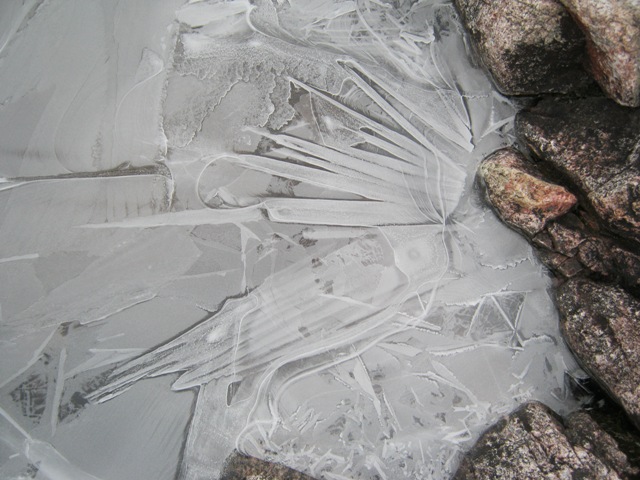
     I like this story because I like ice. It is such a winter treat. Last year there wasn’t ANY ice on our stretch of Lake Superior. I missed watching it form, missed that glimpse into an artist’s heart. The creations are magical. High crystal cliffs, singing ice sheets and shining reflections always refresh the spirit.

     And that transformation from liquid to solid is a natural miracle everywhere. The little frogs in the little lake sleep within an icy grasp. The pages of the Otter Island notebook curl up with frost flowers. And skating on an outdoor rink can open the soul. However, even if the ice man does not cometh, I shall embrace whatever the winter of 2013 gives.

     So Happy New Year everyone and may your 2013 be full of fine, fond memories for the years to come.